
Endometriosis Patient Education Resources for Your Clinic
By: Embodia Team ∙ Estimated reading time: 7 minutes
By: Embodia Team ∙ Estimated reading time: 7 minutes
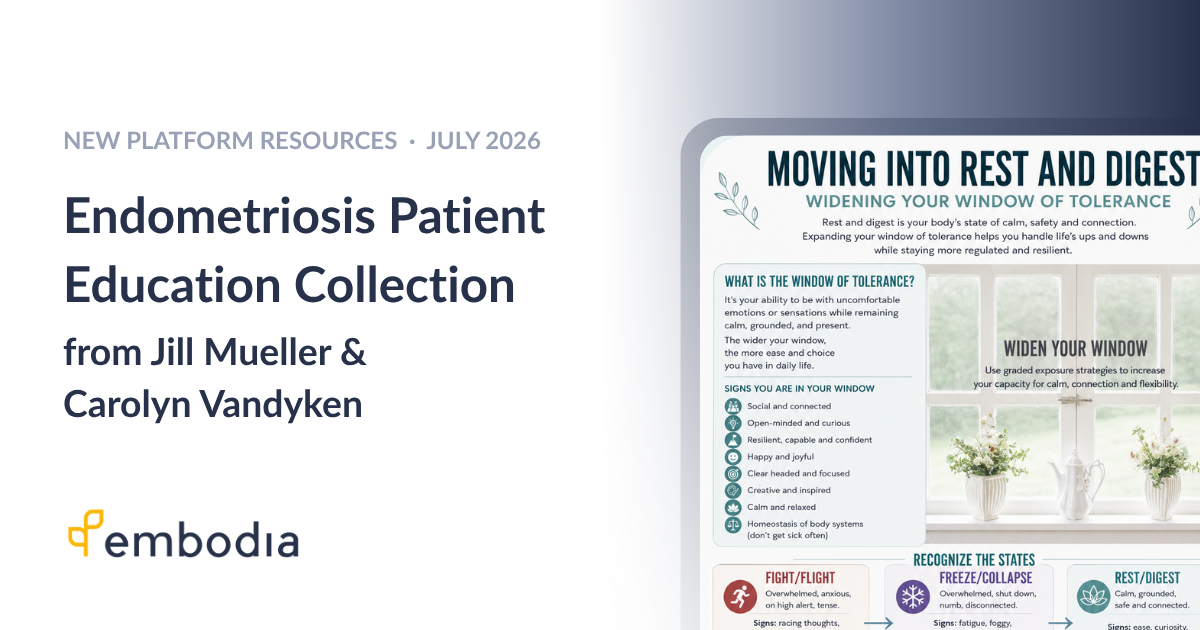
New Endometriosis Patient Education Collection by Jill Mueller and Carolyn Vandyken
Some of the most important work in endometriosis care happens between appointments, when your patient is at home at 2 a.m., Googling why their period pain feels like labour, and finding answers that range from unhelpful to actively frightening.
You can't be there for that moment. But the education you send home with them can be.
Embodia's patient education library now includes a collection of twelve endometriosis resources created by Jill Mueller, pelvic health physiotherapist and founder of EndoTogether, and Carolyn Vandyken, BHSc (PT), CredMDT, CCMA.
Each resource is written in plain, accessible language, grounded in a whole-person, biopsychosocial approach, and paired with an infographic your patients can actually use, and come back to.
Why Patient Education Matters in Endometriosis Care
Endometriosis affects approximately 10% of people born with a uterus, and diagnostic delays stretch across years in many countries. That means many of the people sitting in front of you have spent a long time being told their pain is normal, or that it's all in their head.
Good patient education does two things at once. It validates the patient's experience (pain is real, and it has explainable sources) and it gives them a framework for the strategies you're teaching in the clinic. When a patient understands why you're suggesting lymphatic drainage before ovulation, or why pacing through the follicular phase changes how the luteal phase feels, adherence stops being a compliance problem and starts being collaboration.
What's in the Collection
The twelve resources work as a progression, from understanding the condition, to making sense of pain, to regulating the nervous system, to practical phase-by-phase strategies. Each also stands alone, so you can share exactly what a specific patient needs at a specific point in care.
Understanding endometriosis and the cycle
- Endometriosis-Associated Signs and Symptoms: what patients (and their families) should recognize, including the presentations that are easy to attribute to something else.
- How Our Cycle Works: a plain-language walk through the four phases and how hormonal shifts affect pain, mood, digestion, and energy.
- Connecting Symptoms to Your Cycle: helps patients map their own symptom patterns across menstruation, the follicular phase, ovulation, and the luteal phase.
Making sense of pain
- Sources of Endometriosis-Associated Pain: local factors, peripheral sensitization, cross sensitization, and central sensitization, explained without jargon.
- Conditioned Responses and Period Pain: how the nervous system learns to anticipate pain, and how patients can begin to retrain that response.
- Explaining Whole-Person Treatment for Endometriosis: an honest overview of medical, surgical, and non-medical options that positions rehabilitation within the bigger picture.
Nervous system regulation
- Get to Know Your Nervous System States: fight/flight, freeze/collapse, and rest/digest, described in the physical, mental, and emotional terms patients recognize in themselves.
- Shifting Your Nervous System States: somatic practices matched to each state, so patients aren't handed one generic ‘just breathe’ strategy.
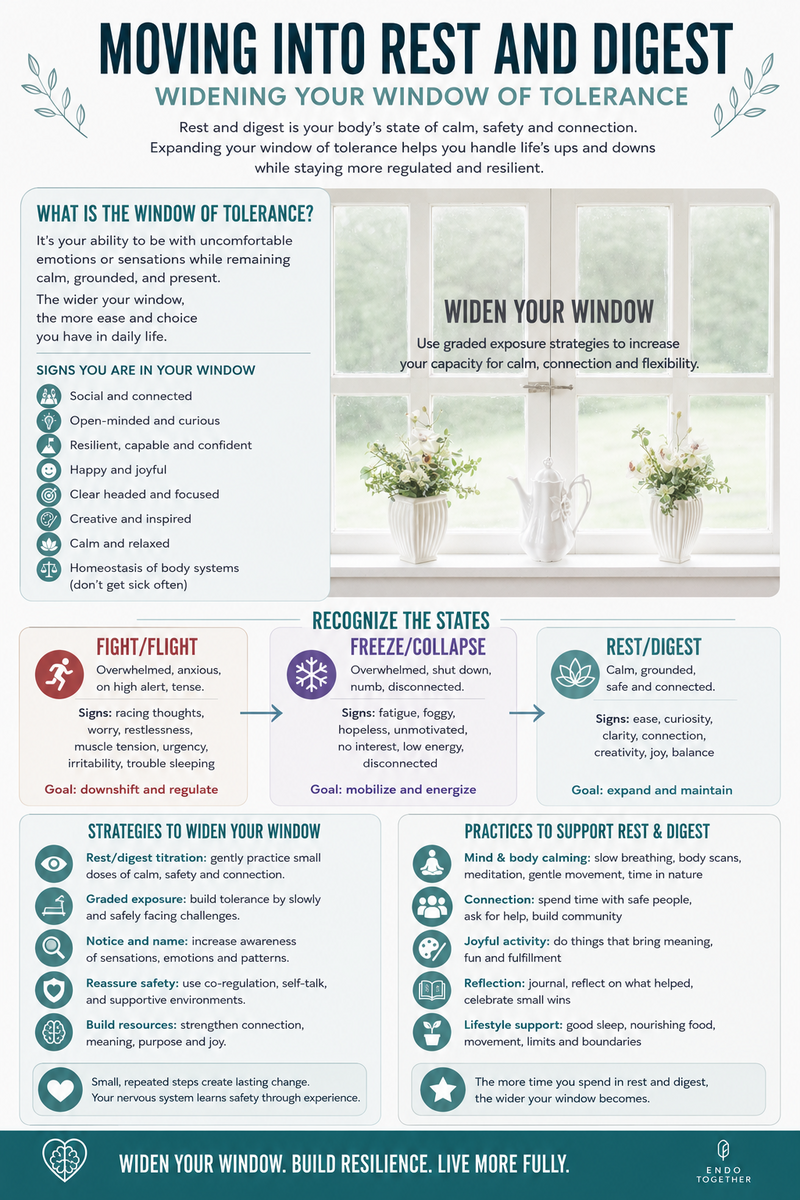
- Moving Into Rest and Digest, Widening Your Window of Tolerance: graded, sustainable ways to spend more time in the state where every body system works best.
Practical, phase-by-phase strategies
- Detailed Phase-Dependent Strategies for Endo / Period Pain: working with the cycle instead of against it, including how to break the boom-and-bust pattern.
- Local and Lifestyle Treatment Ideas for Endo / Period Pain: bowel, bladder, and period pain strategies patients can build into daily routines.
- Lymphatic Drainage for the Pelvis: a step-by-step self-treatment technique, with guidance on when in the cycle to use it.
Built for the Conversations you're Already Having
If you treat persistent pelvic pain, you already spend clinical time explaining sensitization, pacing, and nervous system regulation. These resources don't replace that conversation, they reinforce it. The language mirrors how a knowledgeable clinician actually talks to a patient: honest about complexity, free of catastrophizing, and consistent with a biopsychosocial model of care.
They're also useful before a formal diagnosis. Given how long diagnostic delays run, many of your patients with persistent pelvic or low back pain are still waiting for answers , and education that names and normalizes their experience is part of good care in the meantime.
How to Share these Resources with your Patients
The collection lives in Embodia's patient education library. Share individual resources with your patients digitally, on web, mobile app or Progressive Web App, or print them for patients who prefer paper. Pair them with an exercise program, and your patient leaves their appointment with both their program and the education that explains it, in one place they already know how to find.
Sharing patient education is included with Tier 2 (Patient engagement, $25/month) and Tier 3 (Practice management, $45/month) memberships. If you're on Tier 1 or a free account, you can upgrade at any time. Compare memberships on our pricing page.
Explore the endometriosis collection in your patient education library, and send the first resource to a patient today.
Born Inside the Year of Mentorship
These resources grew out of Jill's June 2026 presentation, A Biopsychosocial Approach to Endometriosis Care, part of Carolyn Vandyken's year-long mentorship program, My Year of Mentorship 2026: Building a Practical Pelvic Health Playbook.
The program brings together Carolyn and an international group of clinical and academic leaders in pelvic health for sessions every other Thursday across the year, plus monthly office hours, a discussion forum, and case-study work with a lab partner. It's mentorship in the real sense, not a course you watch, but a year you practice differently inside of.
The 2026 cohort is full, but registration for the 2027 cohort opens later this year. Join the notification list here to get updates and early access when it does.
About Jill Mueller
Jill Mueller is a pelvic health physiotherapist and the founder of EndoTogether, a platform dedicated to supporting people living with endometriosis. Her focus on this condition grew out of personal experience with period pain and fertility challenges, and she now works to close the gap in education and practical support for people living with endo, and for the practitioners who treat them. She integrates an evidence-based biopsychosocial model across her clinical work, group programs, and international teaching, with somatic training under Dr. Peter Levine and a close working relationship with endometriosis specialist Dr. Mathew Leonardi.
Keep Learning
If you want to build the clinical side of your endometriosis knowledge, start with these two earlier posts:
- Endometriosis in Clinical Practice: Two Courses Every Pelvic Health Clinician Should Know About
- The Pain I Thought Was Normal
For broader, biopsychosocial resources, view Carolyn Vandyken's Whole-Person Pelvic Health Patient Education.
If you're looking for clinical mentorship, get on the notification list for the 2027 cohorot of My Year of Mentorship, led by Carolyn Vandyken, and taught by an international group of clinical and academic leaders in pelvic health has been hand-selected for their excellence in research, teaching, and evidence-informed practice.
Frequently Asked Questions
Who are these resources for?
They're written for patients, in plain language, but they're designed for practitioners to share. Physiotherapists and pelvic OTs treating persistent pelvic pain, period pain, or suspected endometriosis will find them directly usable in care.
Do my patients need a formal endometriosis diagnosis to benefit?
No. The resources cover period pain, cycle-related symptoms, pain science, and nervous system regulation. They are relevant to many patients still waiting on a diagnosis.
How do I access and share the collection?
Sharing patient education with your patients is included with Tier 2 and Tier 3 memberships. You can share resources digitally on web and mobile, or print them. Compare memberships on our pricing page.
Can I share these alongside exercise programs?
Yes. Share patient education through Embodia together with your patient's program, so education and exercises live in the same place.
BKin, BHScPT (Pelvic Health)
Jill has been a physiotherapist since 2001, but her passion for pelvic health was born from personal experience. After years of struggling with period pain and fertility challenges due to Endometriosis, she shifted her focus to understanding and addressing the complexities of this condition. Through deep dives into pain science and Endometriosis research, Jill recognized a significant gap in education and practical support for those living with “endo.” Whether working one-on-one, leading group programs, or speaking internationally, she is dedicated to empowering people with pelvic health conditions and equipping healthcare practitioners with the knowledge needed to provide better care.
Jill is also a founding member and lead physiotherapist of Endometriosis360, an innovative interdisciplinary virtual group program designed to help individuals with Endometriosis. Together, psychology, dietitian, and physiotherapy integrate a biopsychosocial approach and evidence-based strategies to help improve people’s quality of life.
BHSc (PT), CredMDT, CCMA
Carolyn is the co-owner of Reframe Rehab, a teaching company engaged in breaking down the barriers internationally between pelvic health, orthopaedics and pain science. Carolyn has practiced in orthopaedics and pelvic health for the past 37 years. She is a McKenzie Credentialled physiotherapist (1999), certified in acupuncture (2002), and obtained a certificate in Cognitive Behavioural Therapy (CBT) in 2017.
Carolyn received the YWCA Women of Distinction award (2004) and the distinguished Education Award from the OPA (2015). Carolyn was recently awarded the Medal of Distinction from the Canadian Physiotherapy Association in 2021 for her work in pelvic health and pain science.
Carolyn has been heavily involved in post-graduate pelvic health education, research in lumbopelvic pain, speaking at numerous international conferences and writing books and chapters for the past twenty years in pelvic health, orthopaedics and pain science.